
Governance
Learn about our governance structure.
Threefold Framework and the Spheres of School Life
At River Valley Waldorf School, we seek to embody the principles of social threefolding as described by Rudolf Steiner.
This approach recognizes the importance of distinct yet interrelated spheres of social life:
- The Cultural/Spiritual Realm
- The Social/Rights Realm
- The Economic/Community Realm
While Steiner did not recommend a specific organizational structure for schools based on threefolding, we can infer from his work that there are benefits to educational institutions upholding freedom in the school’s cultural life, equity in school policies and shared agreements, and mutual support and interdependence in economic/community life.
We also recognize that maintaining an intentional level of interconnectedness between the three realms is essential for the health of the school as a whole.
Cultural/Spiritual Realm
The cultural realm includes everything of a “spiritual” nature, in the anthroposophical meaning of the word.
This includes math, art, science, thinking, learning, and teaching. In Waldorf education, we talk about teaching as being both an art and a science. We honor freedom of teaching within the context of our school’s policies and shared agreements, with each individual teacher striving to improve, grow, create, and contribute their gifts and knowledge in harmony with the school as a whole.
The cultural/spiritual realm, which is held primarily by the Faculty, brings beauty, meaning, new ideas, and inspiration into the life of the school.
The Faculty circle is primarily responsible for programming, the curriculum, educating the children, parent education, and holding festivals and school events.
Social/Rights Realm
The social/rights realm includes everything that relates to relationships between people.
This includes policies, procedures, shared agreements, decisions around the work each person is responsible for, decisions around how to equitably distribute shared resources, expectations for student behavior, communication, meetings, and more.
We strive for equity in this realm, holding consciousness and intention around how decisions are made and by whom, as well as how disagreements are worked through and resolved. The social/rights realm upholds the agreements and expectations that structure our relationships with other people and brings form to the web of social life. The primary responsibility for the rights realm is held by the Head of School, the Pedagogical Chair, and the Pedagogical Leadership Group (PLG).
Our policies, procedures, and shared agreements are primarily reflected in the Family Handbook, Employee Handbook, employment agreements and job descriptions, teacher schedules, classroom assignments, curriculum documents, and budgets, as well as our practices around shared faculty work, resolving parent concerns, and our approach to student behavior. Work with diversity, equity, inclusion, and justice are values that we strive to weave through all areas of our school, but policy, procedure, and shared agreements that ensure equity, inclusion, and justice live within the Social/Rights Realm.
Economic/Community Realm
The economic realm includes everything that relates to providing for physical needs.
This includes our building and grounds, teaching supplies, materials, teacher salaries, classrooms, and all of the many costs associated with operating a school. As a non-profit independent school, the main sources of income for River Valley are tuition and donations. How abundant the school is relates directly to how much growth and connection we develop as a community.
Maintaining awareness that we are all working toward abundance and growth together is our guiding principle in the economic realm. The Board of Trustees is responsible for developing the strategic plan, approving the budget, and making overarching decisions with the ultimate responsibility of keeping the school open and operational.
The Administration and Communication Team is responsible for implementing the strategic plan, working together in a cohesive way and involving the community, and daily operations. This includes advancement, enrollment, building and grounds, budget and financial management, acquisition of supplies and materials, staying in compliance with state and federal laws and regulations, and upholding our responsibilities as an institution accredited by PAIS and AWSNA.






The School as a Whole
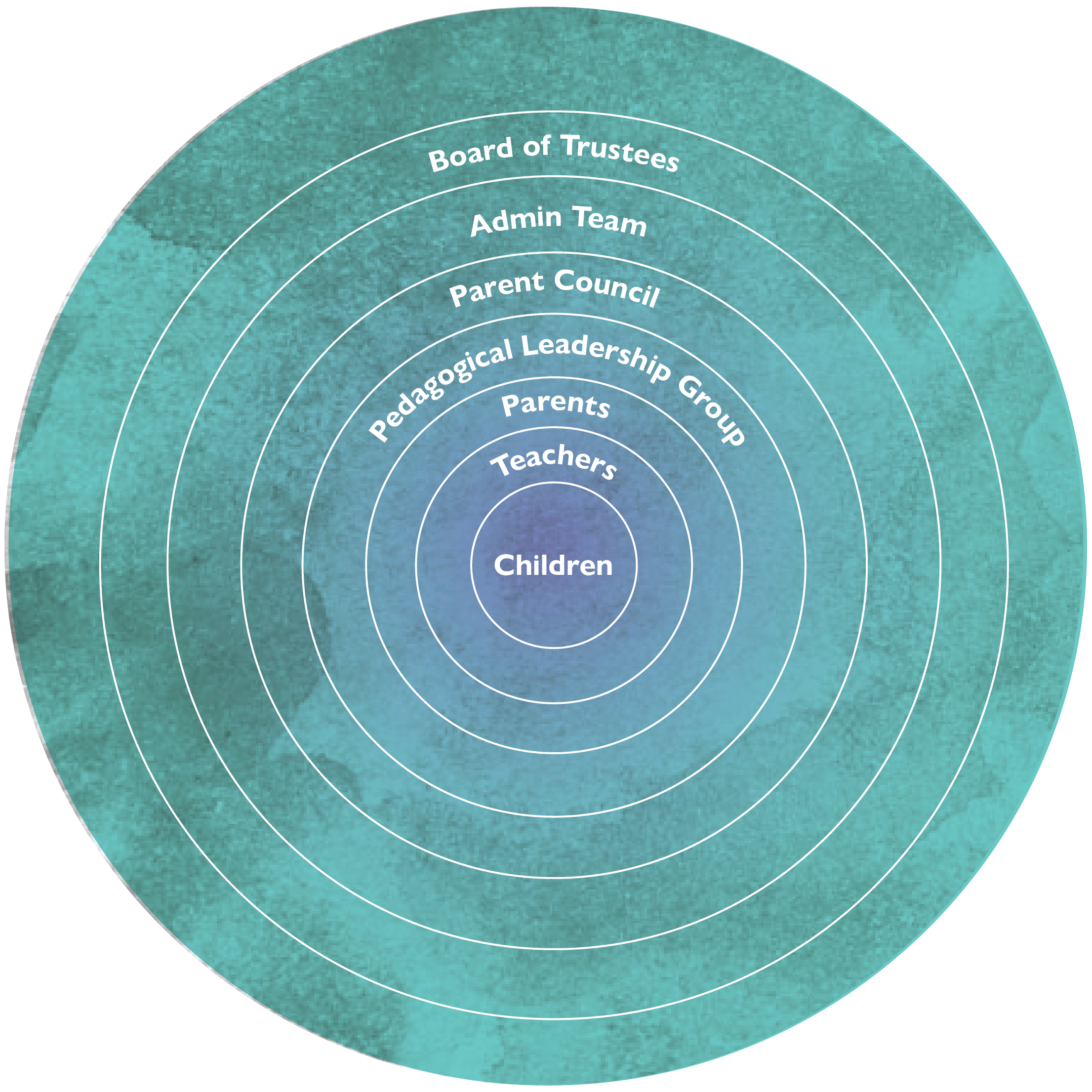
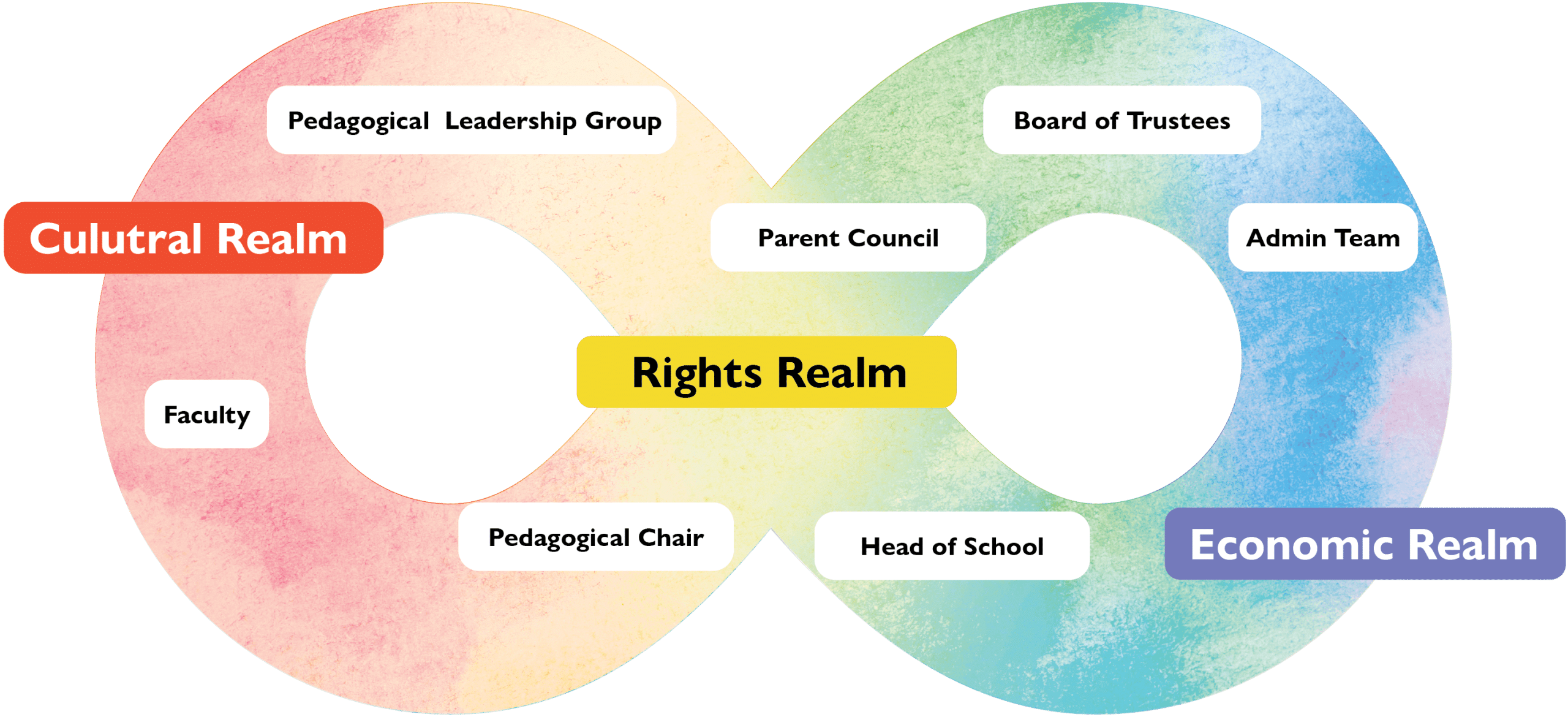
We can picture these three realms as concentric circles of holding, with the children at the center held by the creative, collaborative teaching of the faculty, pedagogical leadership holding the shared agreements and policies that give form to the social life of the school, and the Administration and Board of Trustees working actively toward the abundance, cohesion, and long-term sustainability of the school. We can also picture these three realms weaving together in a lemniscate, with the Faculty as one curve, the Board of Trustees and Administrative team as the other. Pedagogical Leadership and the Head of School hold the Social/Rights realm in the middle, weaving the school together as a cohesive whole. Each decision-making body within the school operates within its own domain of responsibility, while remaining in conversation and collaboration with the others, united in service of the school’s mission and responsive to the ever evolving needs of the children we serve and the world we live in.
Governance in Practice
Governance practices at River Valley emphasize transparency, appropriate delegation, and responsibility aligned with expertise and function.
At River Valley, decisions are generally made through consensus decision-making processes, ensuring that all voices are heard and valued. Through the consensus process, diverse perspectives are considered, leading to more holistic and well-rounded outcomes that reflect the collective wisdom of the group. By prioritizing cooperation and compromise over majority rule, consensus decision-making promotes a sense of ownership and commitment among participants, ultimately strengthening community cohesion and resilience. The Faculty, Board of Trustees, and Pedagogical Leadership group make decisions that have school-wide impact through intentionally held consensus processes.
In addition, the Board of Trustees utilizes a committee structure to facilitate timely and efficient work and decision-making. The Faculty also works with a committee structure, departments meet weekly, and individuals and small groups are delegated responsibility and decision-making authority around specific festivals, events, and other tasks. All of these structures support efficient, clear, and healthy collaboration and decision-making, while adhering to legal requirements and general best practices of independent schools and working in the spirit of consensus.

Head of School
The Head of School (HOS) carries out the policies established by the Board of Trustees. Within these guidelines, the Head of School is accountable for board relationships, organization, planning and analysis, fundraising, academics, program & service support, personnel, finance, institutional image, environment, constituent relations, and enrollment & recruitment.
Pedagogical Leadership Group
The Pedagogical Leadership Group (PLG) carries out the pedagogical management of the school, as dictated by the Faculty approved mandate, and is voted in yearly by the Faculty through an approval voting process. The PLG is chaired by the Pedagogical Chair who provides support and leadership to the Faculty, working in service of the Faculty through collaborative leadership. The Pedagogical Chair works closely with the Faculty, Administration, and the Head of School to plan and implement the pedagogical and administrative objectives of the school community.
Parent Council
The Parent Council serves as a bridge between the school and the parent body, helping to cultivate an active and participatory school culture. This group of parents is composed of representatives from each class. They work to support the Faculty and Administration by helping to build an active community of volunteers brought together for a common purpose which enriches the experience of school life for our children and our families.

Board of Trustees
The Board of Trustees (BOT) at River Valley Waldorf School serves as the school’s governing body, holding ultimate responsibility for its long-term health and mission integrity.
The BOT adopts and upholds the school’s Vision, Mission, and Working Values, ensuring that all policies and strategic decisions reflect these guiding statements. The Board maintains accountability for the school’s financial stability and sustainability, approving the annual budget and safeguarding the institution’s future. A key responsibility of the Board is to select, support, nurture, and evaluate the Head of School, ensuring a strong and collaborative partnership in leadership. Trustees engage in ongoing strategic planning, set annual goals, and conduct regular self-evaluations to strengthen their governance. The Board sustains an active committee structure with clear mandates and expectations, focusing its work on long-range planning rather than daily operations. In fulfilling its fiduciary and legal responsibilities, the Board ensures compliance with all applicable laws and maintains up-to-date bylaws. Committed to continuous improvement, the Board participates in trustee orientation, education, and leadership succession planning to sustain effective, mission-driven governance for the school’s future.

Board of Trustees Nominating Process
River Valley Board of Trustees Selection and Term Conclusion Nominee Selection and Trustee Approval River Valley has a well-defined trustee nomination and selection process.
- In January, the Nominating Committee and the nomination process are announced. This includes enumerating skills and qualities that are important for board service.
- Board members must be at least 21 years old. They can be parents or guardians of current or past River Valley students or can be unaffiliated with the school; River Valley reserves two board seats for faculty, which is common among Waldorf schools. Familiarity with Waldorf philosophies and Anthroposophy are always appreciated. River Valley’s board is deliberate in seeking out potential board members from diverse economics and cultural backgrounds. Potential candidates can be suggested by community members, can indicate their own interest, and often are suggested by staff, committee members, or existing board members.
- The Nominating Committee interviews each candidate to outline what board service at River Valley is like and to assess how well the candidates match the board’s current needs.
- The Nominating Committee recommends the nominees whose combination of skills and desire to serve elevates the incumbent board. The board votes on new trustee(s).
- New trustees are welcomed into their term of service at the final board meeting of the school year. Officers are also approved at this meeting.
Board Term Conclusion In addition to understanding the way that the board is chosen, the board also would like the community to know how board terms may conclude.
- River Valley Waldorf School’s board service is not a lifetime appointment. A River Valley board term is 3 years long, renewable for a second term. The board may approve additional service for exemplary trustees.
- Board members may tender their resignation before their term is up, in writing.
- The board can remove a trustee from the board under extreme circumstances. The process involves notifying the board member in question and a 4/5th affirmative vote of the trustees to approve their separation. River Valley’s Anti-retaliation Policy ensures that someone who brings a concern cannot be fired or otherwise discriminated against in retaliation for reporting a concern.